

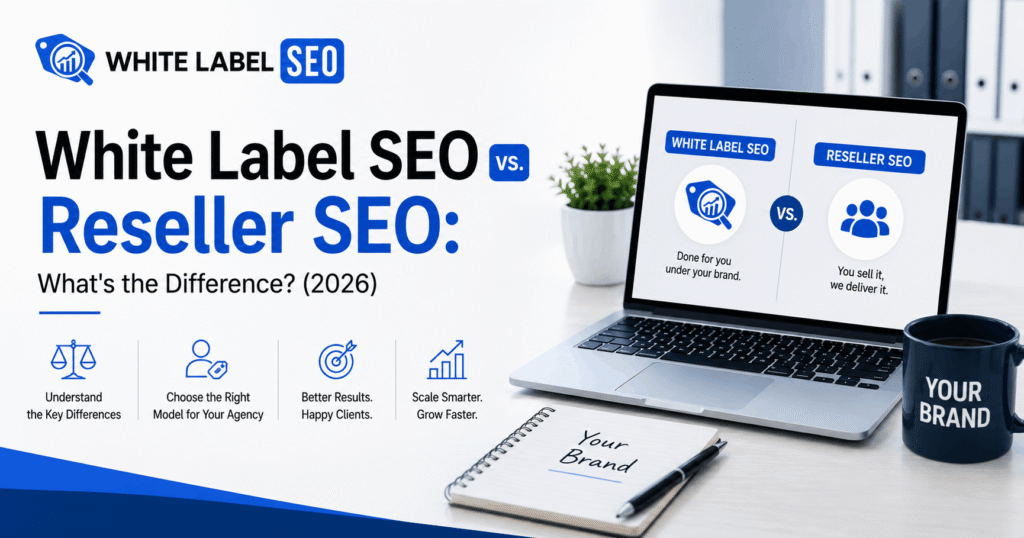
White label SEO and reseller SEO are often used to mean the same thing, but there’s a real difference worth knowing before you sign with a provider. The short version: with white label SEO, the provider is invisible and your agency owns the client, the brand, and the pricing. With reseller SEO, the term sometimes means the same thing — and sometimes means a lighter setup where you pass the client through for a commission and the provider is more visible.
This guide explains both models, lays out the real differences side by side, and helps you decide which one fits your agency. It’s written for agency owners choosing how to add SEO without building a team.
What is white label SEO?
White label SEO is when a specialist provider does the SEO work and your agency sells it under your own brand. The client never sees the provider. Reports carry your logo, and you set your own price. (For the full breakdown, see our guide to what white label SEO is.)
The key trait: you own the client relationship completely. You buy the work at a wholesale rate and mark it up. The provider is your supplier, not a partner the client ever meets.
What is reseller SEO?
Reseller SEO is a broader term, and that’s where the confusion starts. Many providers use “reseller” to mean exactly the same thing as white label — you resell their work under your brand.
But some use “reseller” for a lighter arrangement:
- You refer or pass a client to the provider.
- The provider may be visible to the client, or semi-visible.
- You earn a commission or a smaller margin rather than a full markup.
So “reseller” can mean full white label, or it can mean a referral-style deal. Always ask a provider which one they mean before you assume.
White label SEO vs. reseller SEO: the key differences
The models split on a few practical points:
| Factor | White label SEO | Reseller SEO (referral style) |
|---|---|---|
| Who owns the client | You, fully | Sometimes shared with the provider |
| Whose brand is shown | Yours only | May show the provider’s |
| How you get paid | You mark up wholesale (often 2–3×) | Often a commission or smaller cut |
| Control over delivery | High — you manage it | Lower — the provider may lead |
| Your profit ceiling | Higher, and it repeats monthly | Capped by the commission |
| Best for | Agencies building a real SEO line | Agencies testing SEO with low effort |
⟪ Image: a simple side-by-side comparison graphic of the two models. Alt text: “White label SEO vs. reseller SEO compared: client ownership, branding, and how you get paid.” Compress before upload. ⟫
Who owns the client relationship?
This is the biggest difference. In a true white label model, the client is yours from first contact to renewal. In a referral-style reseller model, the provider may step into the relationship, which weakens your position and your long-term revenue.
How do you make money in each?
White label pays through markup. You buy at wholesale and set your retail price — commonly two to three times the wholesale rate, for a gross margin near 50%. Referral-style reselling usually pays a fixed commission, which caps what you can earn per client no matter how much value you add.
Which model should your agency choose?
For most agencies serious about growth, white label wins. You keep the client, the brand, and the margin — and that margin repeats every month the client stays. The referral model is easier to start but limits both your control and your income.
Choose white label if you want to build SEO into a real, repeatable revenue line and own your clients. Choose a referral or reseller setup only if you want to test SEO demand with almost no effort and are fine with a smaller, capped cut.
⟪ State your own model plainly here. If you offer full white label, say so directly — “We work as a full white label partner: your brand, your client, your pricing.” A clear stance is more useful (and more citable) than a neutral overview. ⟫
Where does AI search fit in either model?
Whichever model you pick, the work now has to include AI search. Buyers increasingly ask ChatGPT, Gemini, Perplexity, and Google’s AI Overviews for recommendations, and those tools name only a few sources per answer. Getting a client named there is a discipline called GEO (Generative Engine Optimization).
A provider that only ranks pages on Google, with no plan for AI answers, leaves your clients slowly losing visibility. Ask about it before you choose — in 2026 it’s part of the core service, not an add-on.
Frequently asked questions
Are white label SEO and reseller SEO the same thing? Often, yes — many providers use the terms interchangeably to mean “you resell our work under your brand.” But “reseller” can also mean a referral or commission setup where the provider is visible. Always confirm which one a provider means.
Which is more profitable for an agency? White label, in most cases. Markup pricing (2–3× wholesale) usually earns more per client than a fixed referral commission, and it repeats monthly.
Does the client ever find out in a white label model? Not if the provider works properly. All reports and communication carry your brand.
Can I switch from a reseller model to white label later? Usually, yes. Many agencies start with a light referral setup and move to full white label once SEO demand proves out. ⟪ Note how you help agencies make this move, if you do. ⟫