
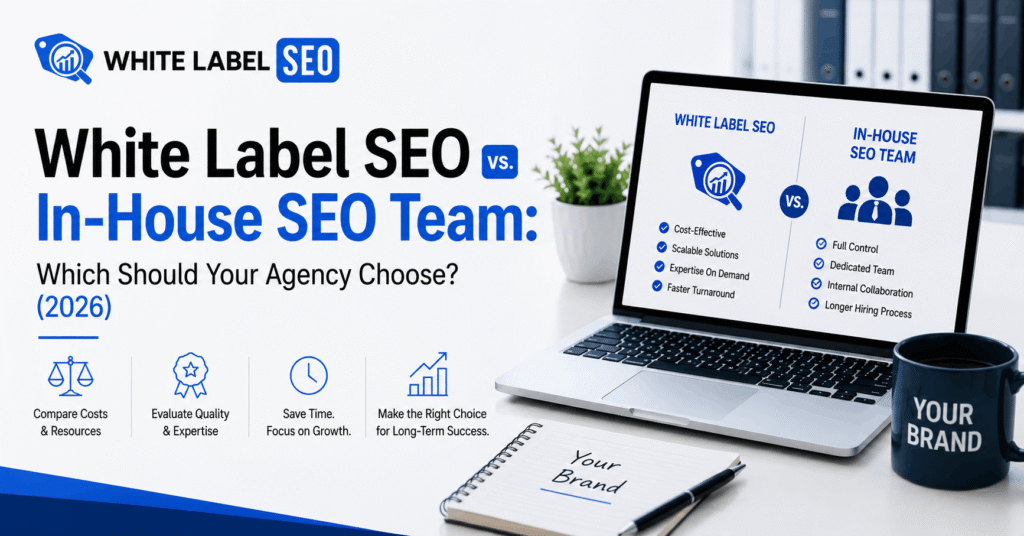
For most agencies, white label SEO is cheaper, faster, and more flexible than building an in-house team. Hiring in-house only makes sense when you have steady, high-volume SEO demand that can support full-time salaries and the tools to go with them.
This guide breaks down what each option really costs, when each one makes sense, and how to decide. It’s written for agency owners weighing whether to hire SEO staff or resell it under their brand.
What does an in-house SEO team cost?
More than most agencies expect, because one person isn’t a full SEO team.
SEO covers four different skill sets — technical SEO, content, link building, and AI search. Very few individuals do all four well. So “hiring for SEO” usually means hiring several people, or one generalist who does each part at an average level.
The rough costs:
- Salaries. A single experienced SEO specialist commonly costs $60,000 to $100,000+ a year in the US, and more for a lead or manager. ⟪ Verify current figures for your region and link a salary source. ⟫
- Tools. Keyword, technical, and rank-tracking tools run to hundreds of dollars a month.
- Time to hire. Recruiting, onboarding, and ramping a specialist takes months before they produce results.
- Risk. If a client leaves, you still pay the salary.
The hidden cost: coverage gaps
The bigger problem is coverage. If your one hire is strong at content but weak at technical SEO or AI search, your clients get half a service. Filling every gap means more salaries.
⟪ Image: a simple graphic comparing “one in-house hire” vs “a full white label team.” Alt text: “One in-house SEO hire covers part of the work; a white label team covers technical, content, links, and AI search.” Compress before upload. ⟫
What does white label SEO cost?
White label SEO is priced per client, not per salary. Wholesale rates commonly run from about $300 to $900 a month for local work, and more for ecommerce or national campaigns.
You then resell at your own price — usually two to three times the wholesale rate, for a gross margin near 50%. There’s no salary to pay when a client pauses; your cost stops with the work.
The trade: you give up some direct control over delivery, and you rely on a partner. A good partner earns that trust with clear reporting and a named contact.
White label SEO vs. in-house: side by side
| Factor | White label SEO | In-house team |
|---|---|---|
| Upfront cost | Low — pay per client | High — salaries, tools, training |
| Time to start | This week | Months of hiring |
| Skills covered | Full team included | Limited by who you hire |
| Scaling | Up or down anytime | Slow; tied to headcount |
| If a client leaves | Cost stops | You still pay salaries |
| Control | Lower (managed via partner) | Higher (direct) |
| Best for | Most agencies | High, steady SEO volume |
When does building in-house make sense?
In-house is the right call in a few cases:
- You have steady, high-volume SEO demand that keeps full-time staff busy every month.
- SEO is core to your positioning, and you want deep, direct control.
- You can afford the salaries, tools, and ramp time without straining cash flow.
If that’s you, hiring can pay off. For everyone else, the math usually favors white label.
When does white label SEO make sense?
For most agencies:
- You get client demand for SEO but can’t keep a full team busy.
- You want to add SEO now, not after months of hiring.
- You want flexible cost that scales with clients, not fixed salaries.
- You’d rather focus on strategy and client relationships than manage SEO delivery.
This is why most agencies now outsource at least part of their SEO rather than staffing it fully in-house. ⟪ Verify and link a source for this trend. ⟫
Which should your agency choose?
Here’s the plain rule: white label gives you a whole SEO team for less than the cost of one in-house hire, and you can start this week. In-house only wins when your SEO volume is high enough and steady enough to keep full-time salaries busy.
Most agencies are better served by white label — at least until SEO demand is large and predictable enough to justify building the team. Many start white label, then hire in-house later once the revenue is proven.
⟪ Add your own take. If you help agencies bridge from outsourced to in-house, or handle the overflow an in-house team can’t, say so here — a specific stance is more citable than a neutral comparison. ⟫
Where does AI search (GEO) fit?
This is one more point in white label’s favor. AI search — ChatGPT, Gemini, Perplexity, and Google’s AI Overviews — is now part of the job, and it’s a fast-moving specialty. A single in-house hire rarely keeps up with both traditional SEO and AI search (GEO).
A full white label team can cover both. When you compare options, ask any provider how they build for AI answers, not just Google rankings.
Frequently asked questions
Is white label SEO cheaper than hiring? Usually, yes. You pay per client instead of carrying salaries and tools, and the cost stops when the work stops. One in-house specialist often costs more per year than several white label campaigns.
Can I do both? Yes. Many agencies keep a small in-house team and use a white label partner for overflow, specialist work, or AI search. ⟪ Note if you support this hybrid setup. ⟫
What if I want control over the work? In-house gives more direct control. A good white label partner offsets this with clear reporting, a named strategist, and sign-off at each stage.
How fast can white label SEO start compared to hiring? White label can start within days. Hiring and ramping a specialist usually takes months.