
White label SEO is a setup where one company does the SEO work and another company sells it to clients under its own brand. Your agency keeps the client and the relationship; a specialist partner does the ranking work in the background, and the client never sees them.
That one idea is the whole model. The rest of this guide explains how it works in practice, why most agencies now use it, what it costs, what to charge, and how to pick a partner that won’t damage your reputation. It’s written for agency owners weighing whether to resell SEO instead of building a team.
What is white label SEO, in plain terms?
White label SEO (also called SEO reselling or private-label SEO) is when your agency sells SEO services under your own name, while a separate provider delivers the work. Reports carry your logo. Emails come from your domain. In a well-run partnership, the client never knows a third party is involved.
The name comes from retail. A manufacturer makes an unbranded product, and a store puts its own label on it and sells it. Digital services work the same way: one company builds the product, another brands it and owns the customer.
It is not the same as a referral or affiliate deal. In a white label setup, your agency keeps full control of the client relationship, sets the price, and manages the outcome. The provider is your supplier, not your partner in front of the client.
How does white label SEO work?
A white label engagement usually runs in five steps:
- Your client asks for SEO. They come to your agency, not the provider.
- You scope the work with your provider. You share the client’s goals and pick a package or plan.
- The provider does the work under your brand. Technical fixes, keyword research, content, links, and local SEO — all delivered so it looks like your team.
- You get a branded report. Your logo, your colors, ready to send to the client or present on a call.
- You keep the margin. You charge your client your rate and pay the provider a wholesale rate. The difference is your profit, and it repeats every month the client stays.
⟪ Add your own process here if it differs — a real, specific workflow is more citable than a generic one. ⟫
⟪ Image: a simple 5-step diagram of the white label SEO flow (client → your agency → provider → branded report → your margin). Alt text: “How white label SEO works: a client hires your agency, a provider delivers the work under your brand, and you keep the margin.” Compress before upload. ⟫
Why do agencies use white label SEO?
Because SEO is in demand, and building a team to deliver it is slow and expensive. Hiring one senior SEO specialist can cost a six-figure salary, and one person can’t cover technical SEO, content, links, and AI search on their own.
Outsourcing solves that. It lets an agency offer SEO without carrying salaries, and scale delivery up or down as clients come and go. Industry surveys suggest most agencies have already made this shift — by some estimates, around 73% now outsource at least part of their SEO rather than staffing it fully in-house. ⟪ Verify this figure and link the source before publishing. ⟫
The main reasons agencies give:
- Add a service without hiring. Offer SEO tomorrow, not after months of recruiting.
- Keep healthy margins. More on pricing below.
- Scale with demand. Take on ten SEO clients or one, without changing your headcount.
- Focus on what you do best. You own strategy and the client; the provider owns delivery.
White label SEO vs. reseller SEO vs. in-house: what’s the difference?
These terms get mixed up, so here’s the plain version.
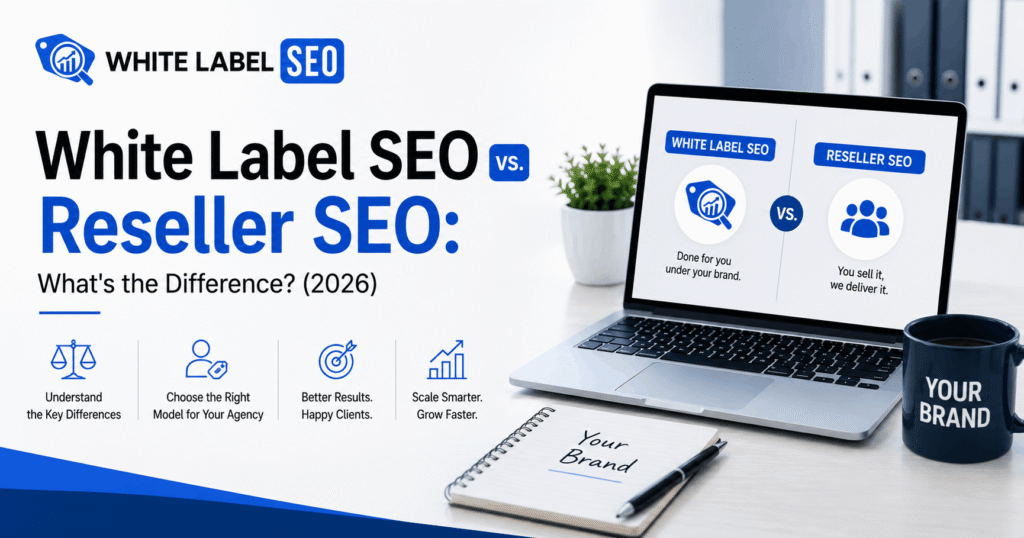
- White label SEO — the provider stays fully invisible. You own the client, the brand, and the price. Reports carry your name.
- Reseller SEO — often used to mean the same thing, though some providers use “reseller” for a lighter setup where you pass leads through for a commission. Always check which one a provider means.
- In-house SEO — you hire and manage your own SEO staff. Full control, but high cost and slow to build.
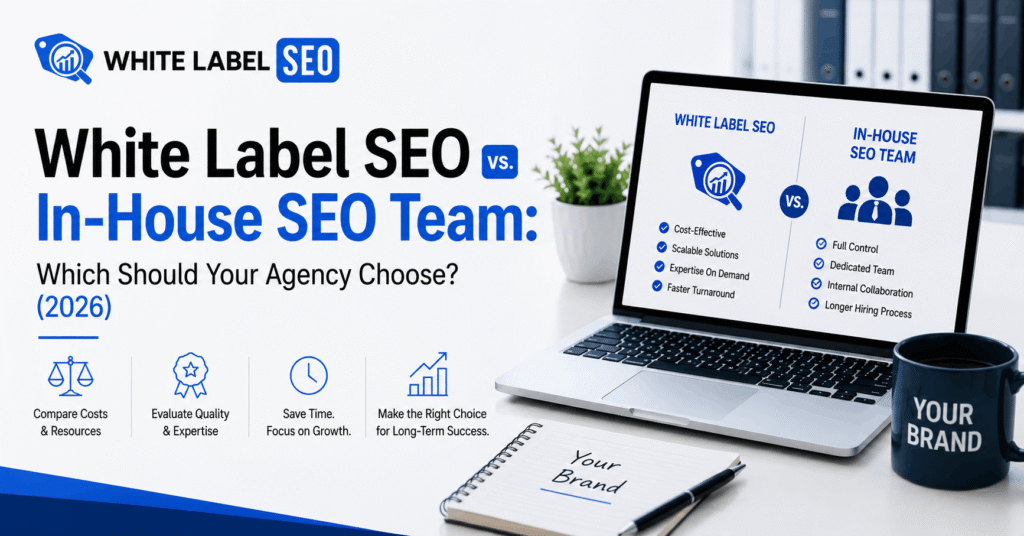
The practical choice for most agencies is white label vs. in-house. White label wins on speed, cost, and flexibility. In-house wins only when you have steady, high-volume SEO demand that can support full-time salaries.
What’s included in white label SEO services?
A full-service white label provider covers the same work an in-house team would:
- Keyword and intent research — the terms your client’s buyers actually search.
- Technical SEO — site speed, indexing, crawl errors, schema, and Core Web Vitals.
- On-page SEO — titles, structure, and content on each page.
- Content writing — pages and articles that answer real search questions.
- Link building and digital PR — earned links and mentions that build trust.
- Local SEO — Google Business Profile, map-pack rankings, and citations.
- AI search (GEO) — structuring content so AI tools name the client (see the next section).
Some providers also handle ecommerce SEO, enterprise SEO, and reporting dashboards. ⟪ List the exact services you deliver, and cut any you don’t. ⟫
How much does white label SEO cost, and what should you charge?
What agencies pay (wholesale)
Wholesale white label SEO usually runs from about $300 to $900 a month for local campaigns, and more for ecommerce, national, or higher-competition work. Be careful with anything priced under $300 a month — at that level, the work is often AI-written content with no human review or low-quality links that can hurt a client’s site.
What to charge your clients (markup)
Most agencies then resell at two to three times the wholesale price, which keeps a gross margin of roughly 50%. So if you pay a provider ⟪ your wholesale price ⟫ a month, you might charge your client two to three times that.
Here’s the math in plain numbers (example figures — swap in your own):
- You charge your client $1,500/month.
- You pay your provider ⟪ your wholesale price ⟫/month.
- You keep the difference, every month, for as long as the client stays.
- Multiply by every client you resell to.
⟪ Image: the margin math as a simple graphic. Alt text: “White label SEO margin example: charge the client $1,500 a month, pay the wholesale rate, keep the difference.” ⟫
The markup isn’t just margin for its own sake. It pays for the account management, reporting, and client relationship your agency owns — the parts the provider never touches.
Why white label SEO in 2026 has to include AI search
Here’s the point most “what is white label SEO” guides miss, and the one that matters most this year.
Ranking on Google is now only half the job. Buyers increasingly ask AI tools — ChatGPT, Gemini, Perplexity, and Google’s AI Overviews — for recommendations, and those tools name only a few sources in each answer. Getting a client named there is a separate discipline called GEO (Generative Engine Optimization).
This is where a lot of older white label providers fall behind. If your provider can only rank pages on Google and has no answer for how a client shows up in AI results, your clients will slowly lose visibility they don’t even see leaving.
Two facts worth knowing:
- Most pages that AI answers cite are already ranking near the top of Google. So strong traditional SEO isn’t optional — it’s the entry ticket to being cited at all. ⟪ Link a source, e.g. recent AI Overviews citation research. ⟫
- Research on generative engines has found that content with clear statistics and cited sources gets quoted more often by AI than vague, generic text. In other words, the specific beats the average — which is exactly why a real point of view and real numbers matter.
So when you choose a white label partner in 2026, ask how they build for AI search, not just Google. If they can’t explain it, they’re already behind.
⟪ Image: a real screenshot of a business cited inside an AI answer (ChatGPT, Perplexity, or a Google AI Overview). Alt text: “Example of a business named as a source inside an AI Overview answer.” Use a genuine screenshot, not a mock-up. ⟫
How do you choose a white label SEO partner?
Judge a provider by your clients’ results and your own profit. A quick checklist:
- Ask how they measure success. Leads and sales, or just traffic and clicks?
- Ask for real proof. Case studies with real numbers beat “trusted by hundreds.”
- Check who owns the accounts. Google, analytics, and tools should stay in your name and your client’s.
- Be wary of guarantees. “Page one in 30 days” is a warning sign, not a selling point.
- Ask about AI search (GEO). If they can’t explain it, keep looking.
- Confirm it’s a real plan, not a template. The strategy should change with each client’s data.
⟪ If you’re the provider, add one honest example here of how you’ve handled one of these well — a real result, a real reporting sample, a real client relationship. That single first-hand detail is what makes this section yours instead of generic. ⟫
Frequently asked questions
Is white label SEO ethical? Yes. It’s a standard supplier arrangement, the same way agencies use outside designers, developers, or PR specialists. What matters is that the work is high quality and the client gets real results. Being transparent that you have delivery partners, if asked, is perfectly fine.
Will my client find out? Not if the provider works properly. Reports, dashboards, and communication all carry your brand. Most clients care about outcomes, not who runs the tools.
How long until a white label campaign shows results? Usually 3 to 6 months for real movement, with competitive keywords reaching page one around month six. SEO builds over time. ⟪ Link to your timeline page. ⟫
Do I need to know SEO to resell it? It helps, but you don’t need to be an expert. Your job is to own the client and the strategy conversation; the provider handles the technical delivery. A good partner will support you on client calls if you want.
What’s the difference between white label SEO and GEO? Traditional SEO gets a client ranking in Google’s normal results. GEO gets them named inside AI answers. In 2026, a strong white label partner does both.